Thinking of knocking down a small front wall? Start here.
Ruwan posted in the Cirencester Community Group looking for someone to demolish and clear a small wall that covers a door entrance at the front of his house. Straightforward job on paper. Worth a few sensible checks before anyone picks up a lump hammer though.
First question: is it load-bearing?
If the wall is inside the house and supporting anything above it, you need a structural engineer or builder to look at it first. Not a handyman. Not Barry who did his own kitchen and fancies himself as a pro. A proper engineer. The cost of getting this wrong is a ceiling that decides to visit the ground floor, which is considerably more expensive than the engineer's fee.
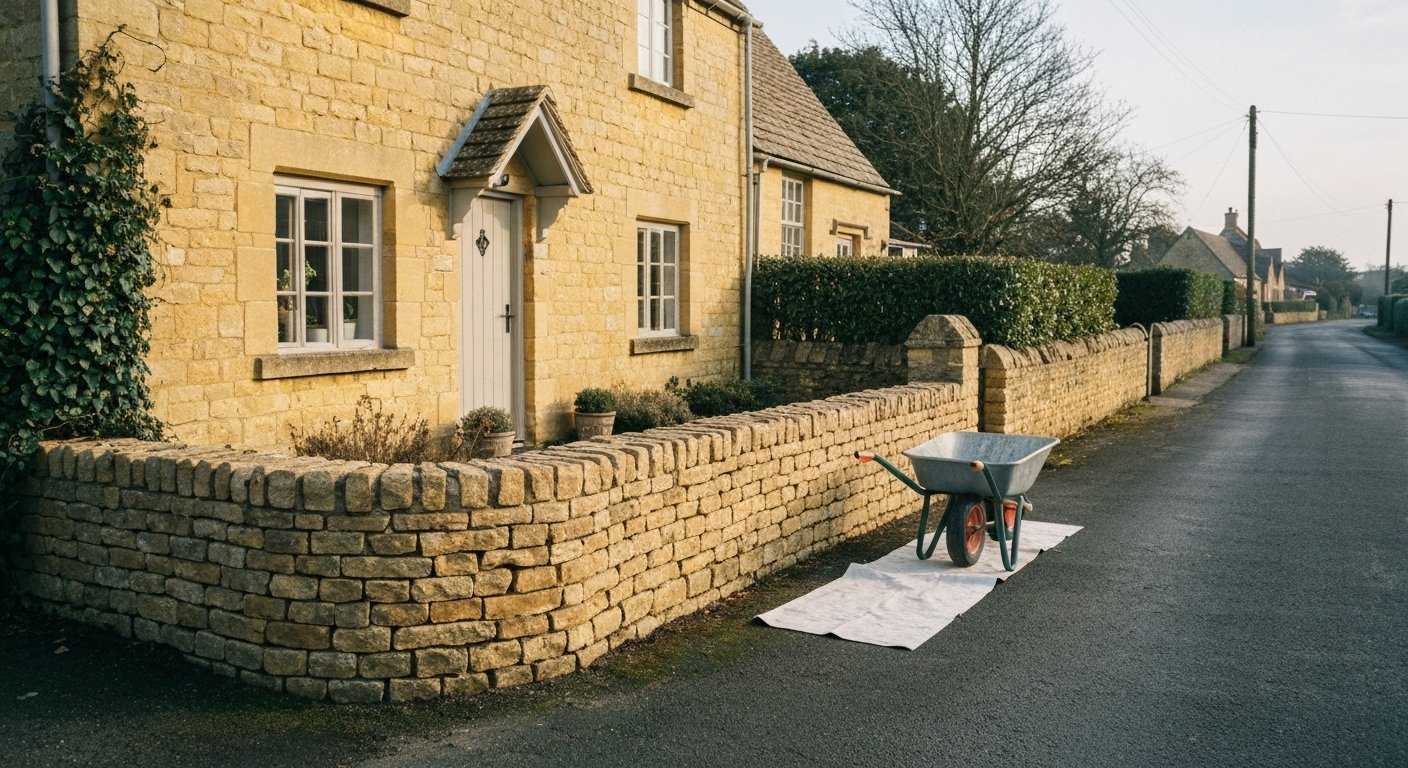
Boundary walls, small garden walls, brick planters, decorative front walls, these are almost always fine to take down. But if it's attached to the house or part of a shared boundary, there's another layer to think about.
Party walls and permissions
A wall that sits on the boundary with your neighbour, or within 3 metres of their house, is likely covered by the Party Wall Act. That means you're supposed to give your neighbour formal notice and wait a minimum of two months before starting. Most people in Cirencester do it the sensible way: pop next door, have a word over the fence, agree it, then crack on. The law still technically applies though. Worth a polite conversation.
If your property is listed or sits in a conservation area, which covers a big slice of central Cirencester, the rules are tighter. Listed building consent can be needed even for small external walls if they're considered part of the original curtilage. Conservation areas are less strict but a front-facing wall might still need planning permission. Cotswold District Council has a planning portal where you can check in about five minutes. Saves a lot of grief.
What the job actually looks like
For a small front wall, maybe 2 or 3 courses of brick and a metre or two long, the job runs roughly like this:
- Dust sheets down and cones or hazard tape if the wall faces the pavement
- Break the top courses down carefully with a lump hammer and bolster. Not a demolition party. Controlled.
- Work down to the foundation. Some walls are just sat on a thin concrete strip. Some are bedded into the soil. You only know once you're down.
- Dig out the foundation if you want a flush finish, or cap it over if you're happy to leave a stub
- Load the rubble into a skip or a mini-skip, or a builder's bag for collection
- Clean up, sweep the path, leave it looking like the wall was never there
For a proper job you're looking at half a day. A day at the outside if the foundations are stubborn.
Skip or no skip?
A small wall of bricks and mortar usually fits in a mini-skip. Three or four builder's bags if you want them collected a few at a time, but mini-skips tend to work out cheaper. Hire costs vary but budget around £120 to £180 for a mini-skip in the GL7 postcode, including permits if it needs to sit on the road. If it's going on your own driveway, no permit needed.
I always tell clients to let me sort the skip. The price is usually the same and I can time it so the skip arrives the morning we start and leaves the day we finish. Otherwise you can end up with a full skip blocking your drive for a week while the company finds a slot.
Honest bit: know what you're taking on
Demolition feels simple until the first brick comes away and you realise the one behind it is loose too. I've had small walls that came down in 20 minutes and a "small" wall in Watermoor that took two people a full day because the cement was like concrete and the foundations went down half a metre. The photos never tell you everything.
Got a wall that needs to come down?
Small boundary walls, internal partitions, brick planters. If it's not structural and it's not listed, I can usually crack on the same week. Quote over the phone.
General odd jobs